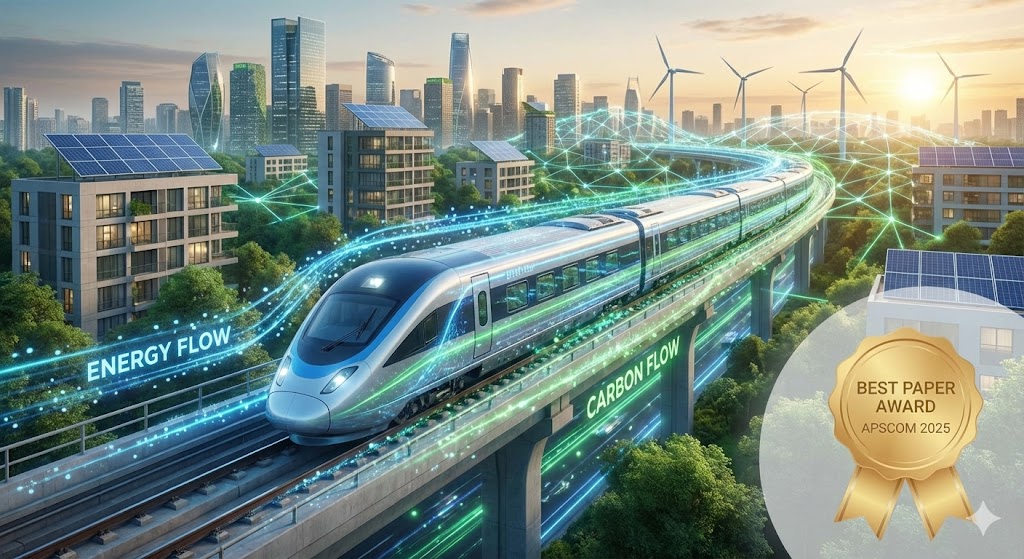
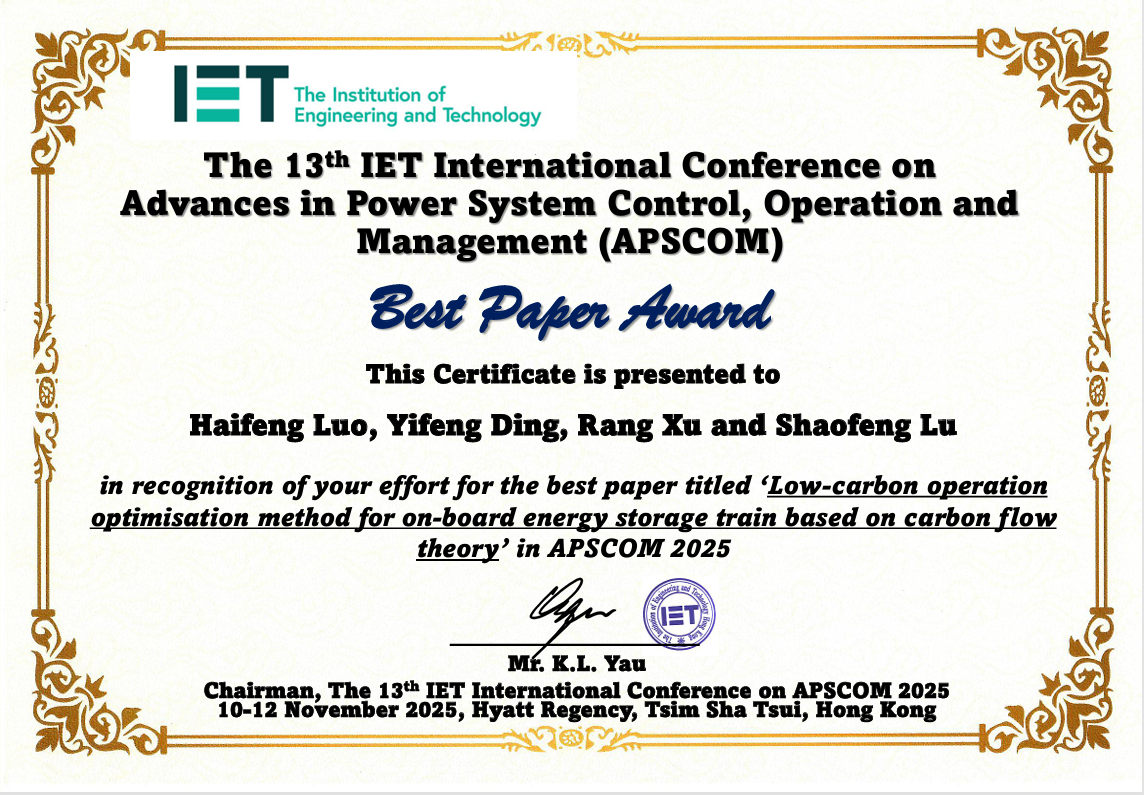
I am thrilled to share that our research paper, “Low-carbon operation optimisation method for on-board energy storage train based on carbon flow theory,” has been honored with the Best Paper Award at the 13th IET International Conference on Advances in Power System Control, Operation and Management (APSCOM 2025).
Held from November 9-12 at the Hyatt Regency Tsim Sha Tsui, Hong Kong, APSCOM is a premier forum for power engineering professionals. Receiving this recognition reinforces the importance of integrating advanced low-carbon theories into practical rail transit applications.
1. Why This Research Matters: The “Energy vs. Carbon” Gap
As the world moves toward Carbon Peaking (2030) and Carbon Neutrality (2060), urban rail transit faces a unique challenge. While trains produce zero direct emissions, their massive electricity consumption leads to significant indirect emissions at the power source.
Traditionally, engineers have focused on Energy-Efficient Train Control (EETC), assuming that saving energy equals saving carbon. However, our research reveals that with the rise of multi-source energy systems (grids, photovoltaics, and energy storage), lower energy consumption does not strictly equal lower carbon emissions.
Key Contribution: We applied Carbon Emission Flow (CEF) theory—originally used in power grids—to the domain of train control with onboard Hybrid Energy Storage Systems (HESS). This allows us to track “virtual carbon flows” dynamically as the train moves, charges, and discharges.
2. About the Research Team
This work was conducted at the Shien-Ming Wu School of Intelligent Engineering, South China University of Technology (SCUT).
Led by Prof. Shaofeng Lu, our team specializes in the intersection of intelligent control and sustainable infrastructure. Our research focuses on sustainable railway systems, particularly energy-efficient train control, hybrid energy systems (such as Battery Energy Storage Systems and Hydrogen), and the integration of renewable energy sources like solar PV.
Authors: Haifeng Luo, Yifeng Ding, Rang Xu, and Shaofeng Lu.
3. Main Outcomes: The “Carbon Responsibility” Shift
Our study proposes a stepwise optimization framework:
- Stage 1: Optimize the speed trajectory to minimize energy demand using Mixed-Integer Linear Programming (MILP).
- Stage 2: Optimize power allocation using Carbon Flow Theory.
The “Carbon Responsibility Container”
We introduced a novel concept where onboard energy storage devices (Batteries and Supercapacitors) act as “Carbon Responsibility Containers”. They absorb “carbon flow” during charging (from the grid or regenerative braking) and release it during discharging. This allows the control system to decide when to use stored energy based on its “carbon price” rather than just its energy value.
The Results: A 2.39% Carbon Reduction
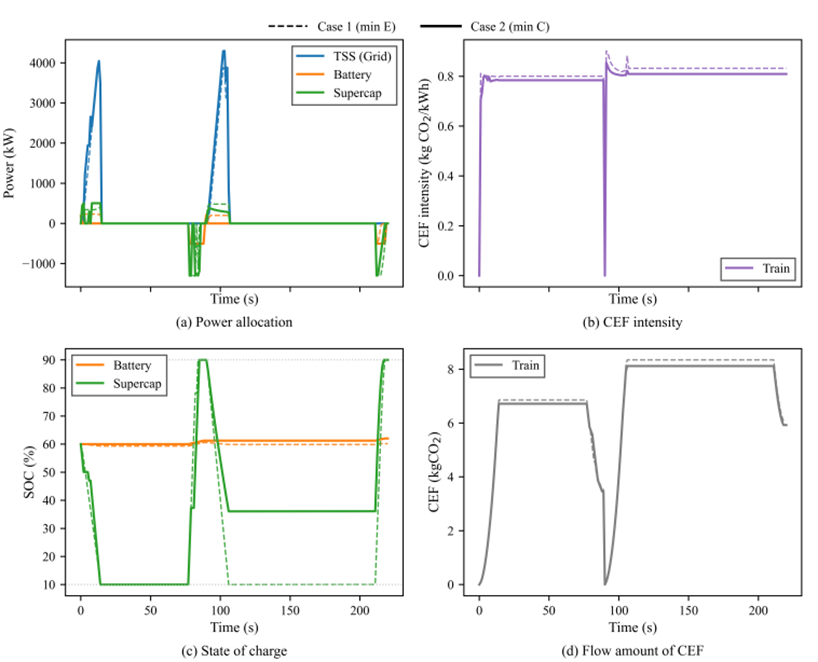
Using real-world data from Guangzhou Metro Line 7, we compared a traditional Energy-Minimization strategy ($\min E$) against our Carbon-Minimization strategy ($\min C$). The results were compelling:
The Carbon-Optimized strategy achieved a 2.39% reduction in carbon emissions while energy consumption increased by only 1.51%.
This proves that by intelligently managing the “Carbon Flow” of onboard storage, we can achieve deeper decarbonization without significant energy penalties.
4. Future Outlook: AI and System-Wide Integration
This award-winning paper is just the beginning. Looking ahead, our team is expanding this research in two exciting directions:
- Integration with Traction Power Systems: We aim to extend the Carbon Flow Theory beyond individual trains to the entire traction power network. This involves exploring how multiple trains and stationary energy storage systems can collaborate to share low-carbon energy system-wide.
- AI for High-Level Autonomous Operations: To handle the complexity of real-time carbon data and uncertain renewable generation (like PV), we are developing AI-driven autonomous control systems. These will allow trains to “self-optimize” their carbon footprint in real-time, paving the way for the next generation of smart, green rail transit.
We look forward to sharing more updates as we continue to drive the rail industry toward a sustainable future!
 Shaofeng Lu